FlowBnB
🚧 In active development
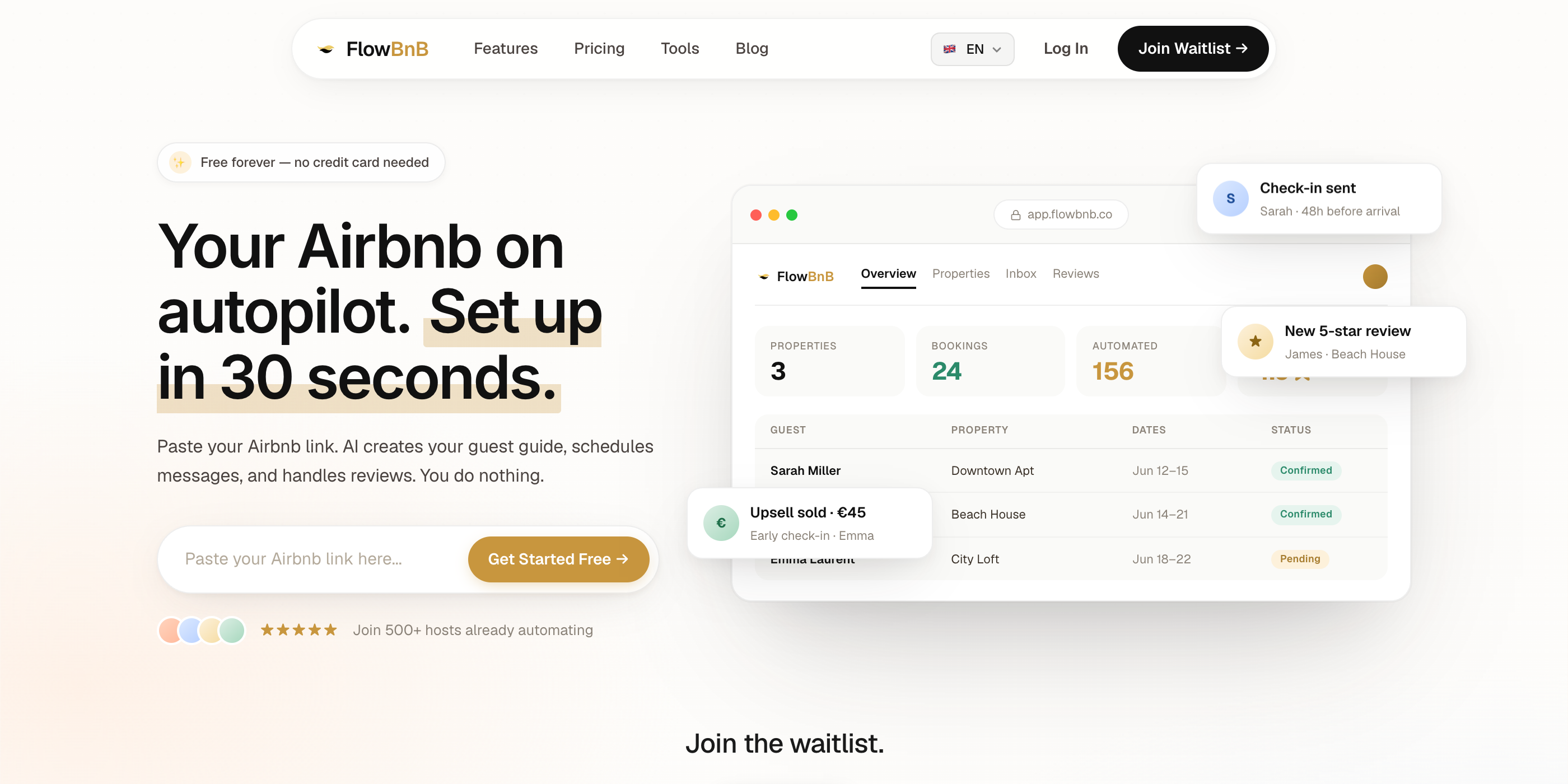
A SaaS that automates guest communication for Airbnb and short-term rental hosts: paste a listing link and AI sets up the guest guide, automated messages, review management and upsells.
Problem
Short-term rental hosts answer the same guest questions over and over — check-in details, wifi, house rules — and lose hours every week to repetitive messaging, review follow-ups and manual upsells.
Solution
I'm building FlowBnB solo, end to end: a host pastes their Airbnb link and AI configures the whole workspace in seconds. The product ships as a Turborepo monorepo with two Next.js apps (marketing site and dashboard) on Vercel, backed by Supabase, with Stripe subscriptions, transactional email and scheduled automations.
Tech stack
- TypeScript
- Next.js
- React
- Supabase (PostgreSQL)
- Stripe
- OpenAI API
- Resend
- Turborepo
- Vercel
Architecture
Monorepo with two independently deployed Next.js apps. The marketing app owns the public site, blog, free tools and waitlist/lead APIs; the dashboard app owns authentication, all business APIs and the product itself. Shared packages hold the Supabase clients (server/client, with cross-subdomain cookies), email and AI integrations, plans configuration, feature flags and the design tokens. Two Vercel projects deploy from the same repo.
Technical highlights
- Turborepo + pnpm monorepo: marketing app (flowbnb.co) and product dashboard (app.flowbnb.co) sharing lib/ui/types/i18n packages
- Cross-subdomain Supabase auth with shared cookie domain between marketing site and dashboard
- Stripe subscription billing gated behind a single feature flag, so the full paid flow is testable on staging while production runs waitlist-only
- AI onboarding that configures a property from an Airbnb listing link
- Transactional email (Resend), SMS (Twilio) and 6 scheduled cron automations on Vercel
- Real dev workflow: protected main, develop → staging previews, deploy checklists and runbooks
Technical decisions
- Split a single app into a monorepo so the marketing site and the product can evolve and deploy independently while sharing code.
- Gated every paid surface behind one environment variable instead of scattered checks — production runs waitlist-only while staging exercises the full Stripe flow.
- Launched with a waitlist + survey funnel to collect real host data (property count, platforms, pain points) before spending on ads.
Challenges
- Making authentication work seamlessly across subdomains (flowbnb.co and app.flowbnb.co) with Supabase SSR cookies.
- Designing the AI onboarding so a single Airbnb link produces a useful, editable guest guide instead of generic filler.
Results
- Fully functional product in production with a free beta, a growing waitlist, and a staged launch plan.
Future improvements
- Finish the monorepo migration to main, expand channel-manager integrations, and open paid plans publicly.
What I learned
- Shipping a real SaaS solo teaches everything at once: product, infra, billing, email deliverability, and the discipline of staging environments and runbooks.